An electric vehicle
We bought a new car. A Kia EV5 in fact. Why did we pick that one, and how is it going?
We got an EV! I had been thinking for a while now that our next car should be an electric vehicle. Our good friend Jane had got one last year (and prior to that had a hybrid), and was a strong proponent making the switch, so it was definitely on my radar. We also attended a really informative community seminar early last year, where lots of EV owners brought their along cars for people to look at and ask questions. A few speakers gave really good presentations on what it’s like owning an EV and the current state of the market. Given our driving patterns it just felt like the logical choice.
Our old car (a Kia Sorento 7 seater SUV) has had a good run, but it had recently ticked over 300,000 kms and while it was still going remarkably well (we did a road trip from Adelaide to Sydney earlier this year with it), it was likely going to get more expensive to keep on the road.
In hindsight I really should have done something about this last year - but I didn’t count on a world-wide oil shortage, which then encouraged a lot of other people to start buying EVs too!
I also decided to take advantage of using a novated lease through work. There’s some helpful government discounts that made this an option to consider. Some employers might only support a single lease provider, but SixPivot doesn’t have any such limitation. I looked around at a number of leasing companies and also spoke to my work colleagues who were already leasing to hear their experiences. That’s how I ended up choosing Fleetcare (If you’re interested in using them, let me know and I’ll share a referral code with you, and we both get a $250 gift card each if your lease is settled).
After a decent amount of research we settled on a Kia EV5. The base model (which we got) has a ~400km range and quite decent boot space compared to some other cars we looked at. It’s a 5 seater SUV. Not quite as big as our old Sorento, but it does pass the “Cello” test. That’s where you take a full-size Cello in its case and try and fit it into the car boot without having to put down one of the back seats. It’s a lot more modern than our old car, but there’s still a bit of “Kia” familiarity to it.
I’d also spent a bit of time looking at our past driving history and running costs to try and get a good idea of how much we could afford to budget for a new car. (The running costs also proved useful when filling out the lease documentation).
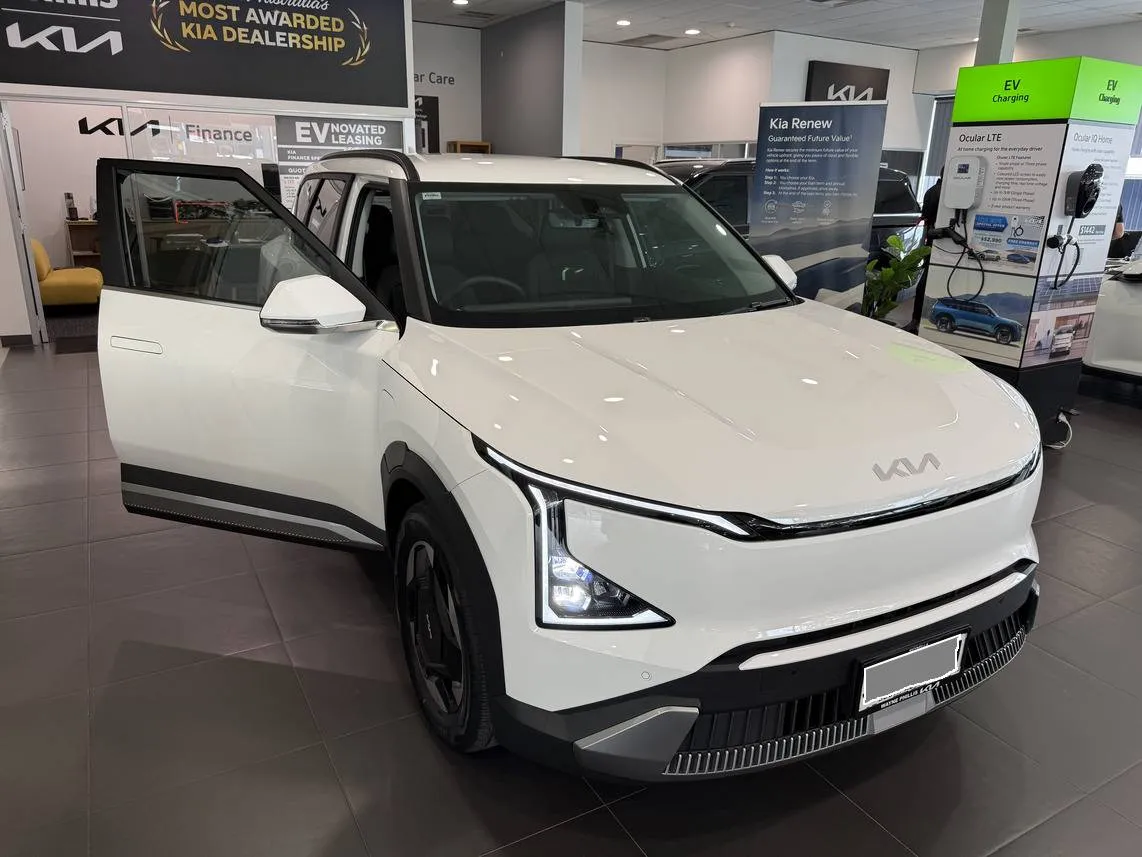
Some other brands I tried felt like the usable area of the windscreen was reduced quite a bit, especially around the rear-view mirror area - almost like driving with blinkers on. Maybe that’s ok for shorter people, but as someone slightly taller, that was noticeable to me. A number of new cars seem to be adopting a US layout with indicator and wiper controls on the “wrong” side of the steering wheel. Not a deal breaker, but it was appreciated that the EV5 keeps with what I’m used to - wipers on the left, indicator on the right.
There’s also a lot of variation across EV models as to how the gear stick is located. Not that you usually have more than just forward, park and reverse. Some have a dial in the centre console, some have what looks like a traditional gear stick, and some (like the EV5) have the gear stick as an extra “stalk” on the steering wheel.
A few bumps
About a week after we got the new car, I started noticing some weird error messages appearing on the dashboard display. They’d appear briefly and then go away, but a small warning icon would remain. They’d disappear when the car was turned off, but then another error would show up at some stage later. The strange thing was it wasn’t always the same system that the error was referring to. They weren’t predictable either.
Here’s one that I did manage to get a photo of. The text would only appear for a few seconds, but the warning icon would stay in the bottom right of the display until you turned off the car.
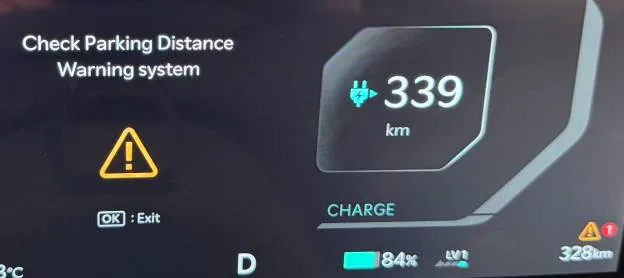
I contacted our car sales guy to ask what the message meant, and he referred it to their service department. They asked for me to bring it in for a day. The result of that was they said they needed to book it in again for an extended period as they weren’t sure what the problem was.
As a software developer, the worst kind of bug is one that you can’t reproduce. Given the amount of software that runs inside a car these days, I was worried this might be one of those situations. But I was somewhat relieved to hear that when they plugged in their diagnostic tools into the car the technician could see a whole bunch of errors being logged. So it wasn’t just me.
A couple of weeks later we took it back and it stayed in for a few days, during which they informed me they’d referred it up to Kia Australia. Finally they identified a fault with a high-voltage cable being too close to other wiring and causing interference and the ‘phantom’ warnings.
It was disappointing to be without our new car for about a week all up (at least we were given a loan car) but hopefully that problem is permanently resolved.
Bells and whistles
The new car is quite an upgrade from the old Sorento. Like most new cars on the market these days, it comes with a fully electronic dashboard, with navigation and all kinds of driving assistance features. Many of these like to go ‘ding’! The steering wheel will rumble if the car thinks you’re going out of your lane (or if it thinks you’re about to change lanes and bump into a car).
As an avid Double-J Radio listener, I do appreciate having DAB digital radio built in.
Apple CarPlay is also nice, though maybe I’m “holding it wrong” as I’ve missed a few messages sometimes, that I thought I would get notified about. Also a bonus to be able to rely on Bluetooth and retire the old Aux cable. There can be a bit of competition now as to whose phone is the one to connect first and choose their music!
The built-in speed limit warnings are handy, except when they’re not. As I understand it, the car can detect speed limit signs, but it presumably has some fallback mapping data that it defaults to. The quality of that data is variable. Some roads that have changed speed limits in the last year are obviously still using the old speed limits in its dataset. Others seem to have weird limits that make no sense - eg. there’s a couple of roads where it insists the limit is “55km/h” - there is never a “55” speed limit. 40, 50 or 60, but not 55. I wish I knew how to submit updates or give feedback.
The EV5 does come with V2L (Vehicle to Load) with a standard Australian power point inside the boot. I haven’t used it yet, but it’s good to know the option is there. Handy if you’re out on a picnic and want to boil a kettle, or if we ever have another massive storm with extended blackouts then we could use the car’s battery to tide us over.
The car came with a standard charging cable (known by some as a ‘granny’ charger), that just plugs into a regular wall socket. My plan was to see how we went with that, knowing that it may take a while to recharge. In the short-term I could always take the car to a nearby fast-charging point, but if it became a regular problem then installing a higher-powered home charger would always an option.
Range anxiety?
The old car would average around 600km on a full tank. The new car has a nominal range of 400km, but I’ve found it can vary a bit depending on the kind of driving you’re doing. Shorter drives to the shops or around town are easy. The longest we’ve done so far is a round trip to Port Elliott/Victor Harbor (~145km) which has been fine as well. I did notice that the faster highway driving does use up a bit more battery than just the normal suburban trips. But that’s pretty normal for current generation EVs.
The more we use it, the more we get a feel for what it can do. I’m looking forward to taking on a longer drive. Yes, we’ll need to plan out our stops for recharging, but given you really should stop every couple of hours for a break, I think that should coincide nicely.
And then there’s the joy of driving past a petrol station and just ignoring the price of petrol. Probably the only downside to that is it means I need to be more intentional about stopping in occasionally just to keep the tyres up to pressure.
So yes, I’m happy we chose it.